Compliments or Criticisms?

There is extraordinary power in the words we speak to one another. Be they negative or affirming, they are capable of completely making or breaking a moment, a day, a relationship. This, of course, is more true of some of us than others. I am a word person. I have never taken any of the “love languages” tests, but if I did, I feel fairly confident that ‘words of affirmation’ would be the primary vocabulary in which I speak. (‘Receiving gifts’ would be second, but that’s an entirely different blog post!) My husband, on the other hand, is an ‘acts of service’ kind of guy. He will do whatever needs doing without blinking an eye. He thrives on taking care of me and our son. Need groceries? He will go, after a long day at work, to get them in order to spare me the hassle of going with a toddler. Is there a huge mess after the elaborate supper I just created? He’ll clean it all up while Aiden and I play so that I don’t have to cook and clean. Getting behind on the laundry? He can do it while listening to a podcast (one of his favorite pastimes), so no biggie! I know that I am extremely lucky. Many women would kill for what I have. I recognize these things are a demonstration of love that I would never trade. Unfortunately, they just don’t speak to me as a gesture of affection. Whereas a note left by my coffee in the morning will make my entire day. Or an offhanded remark about my outfit will make me feel sexy for a week. Why is it that such seemingly frivolous things seem to speak so much more loudly to me than practical things that really matter? I think the answer lies in the availability, or lack thereof, of such affirming words. Not just between husbands and wives but in all types of relationships. We as a society are, unfortunatly, not in the practice of lifting one another up – being generally encouraging or even interested in others. And this lact of verbalizing about things we admire, makes the rare compliment seem so unusual and valuable. I want to change this aspect of society. Every time I think something nice about someone else, I want to have the nerve to speak it, knowing it will probably make their day.

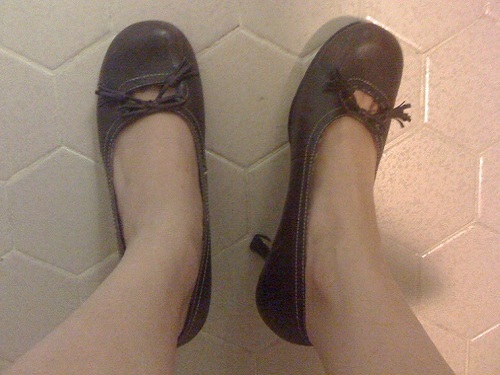
We tend to be so much better about doing this naturally with children. “Good job, sweetheart! What a beautiful picture you drew!” And yet, for some reason, we assume that, as adults, we just don’t need encouragement. We’ve all got this thing called life down pat by now, we shouldn’t need someone telling us what a good job we’re doing at it. But even if we don’t need the encouragement to succeed, it sure makes the path so much more rewarding! My husband recently went on a short business trip and when he returned, he seemed to be buzzing for days. When I asked him where all his positive energy was coming from, he said that he had met someone on his trip who was exceptionally good at being interested in and encouraging everyone that he met. And it was sincere and uplifting and inspiring. Why are people like this so rare? Why do we find it so hard to say nice things about and to one another? Shouldn’t this be the norm rather than the exception? I have a friend who taught me to fly a remote control helicopter. I was a natural, if I do say so myself, but I didn’t have to say so myself because he said it to me. As I was leaving, he kissed me on the head and said I did such a good job and that it was rare for someone so new to flying to do so well. Such a small and insignificant thing, but it made me feel good for days. I hope and pray we are training our son well in this aspect of life and relationships. And lately, he’s been complimenting me at such a rate, that I think we are succeeding. The other day as he was bent over for me to wipe his booty, he said, “Oooh, mama, I yuv your bootiful shoes!” I smiled all day. Later that week as I was trying on some clothes at a thrift store, he repeatedly told me, “I yike dat one! Dat one’s nice mama!” And these are not just the cute nothings of a two year old. They mean something! Perhaps we should all take note and learn to praise with the unreserved honesty of a child. If we complimented half as much as we criticized, we’d probably all feel a lot better about ourselves . . . or at least our footwear.

The Elegance of the Hedgehog

I have just finished reading an extraordinary book entitled, “The Elegance of the Hedgehog.” I read it for a book club that I lead once a month, but I did not select it. It was chosen by a friend of mine and I must admit, I was sceptical at first. As a matter of fact, I was still sceptical a quarter of the way in, much like one is sceptical of an odd new acquaintance that they just might like to befriend, but they’re not quite sure. Yet the story and the characters so richly developed as I made further progress, that I could not help but be swept away by the poignance, beauty, and humanity that was exhibited in it’s pages. As I began the book, I felt that there was a pervasive cynicism that would be hard to overcome for someone as deliberately optimistic as myself. The two main characters were so isolated in their own minds, that they themselves had a hard time overcoming it. But it was this change from cynicism to hope that gave the book it’s depth. It was utterly beautiful to walk beside, and actually in the very minds of these two women as they learned to believe in humanity and the endless potential hidden in some people that we are fortunate enough to really see and call friends. The story is saturated in philosophy and psychology, which can make it a bit burdensome at times, but also intellectually stimulating and enriching. Because it ends with such a worthy example of what I am trying to accomplish here in my blog, finding beauty in the little thing and using those beautiful moments as building blocks of our happiness, I thought I would share the book with my readers along with my definite stamp of approval.

“In a bourgeois apartment building in Paris, we encounter Renée, an intelligent, philosophical, and cultured concierge who masks herself as the stereotypical uneducated “super” to avoid suspicion from the building’s pretentious inhabitants. Also living in the building is Paloma, the adolescent daughter of a parliamentarian, who has decided to commit suicide on her thirteenth birthday because she cannot bear to live among the rich. Although they are passing strangers, it is through Renée’s observations and Paloma’s journal entries that The Elegance of the Hedgehog reveals the absurd lives of the wealthy. That is until a Japanese businessman moves into the building and brings the two characters together. A critical success in France, the novel may strike a different chord with some readers in the U.S. The plot thins at moments and is supplanted with philosophical discourse on culture, the ruling class, and the injustices done to the poor.”
Review by Heather Paulson found on Amazon.

Dance with more than just your toes!

I admire the lack of inhibition in children.  Of course it has it down side, but for the most part, I think it is a trait to be nurtured and emulated.  Children have not yet learned to be afraid of what other people think of them.  They simply experience the world around them and engage it with undaunted enthusiasm and vigor.  A rather potent example of this is dance.  We are all hardwired to dance.  It is part of our nature as human beings to physically respond to music.  I have never met a young child who did not dance.  It begins almost as soon as they are able to make voluntary movements and continues till the time they learn to be afraid.  A baby who cannot even sit up by himself will bob his head to music and older children will jump and bounce and swing around the dance floor with an excitement that cannot be held back – as though they can’t help it.  And why should they?  It’s natural, joyous, active, FUN.

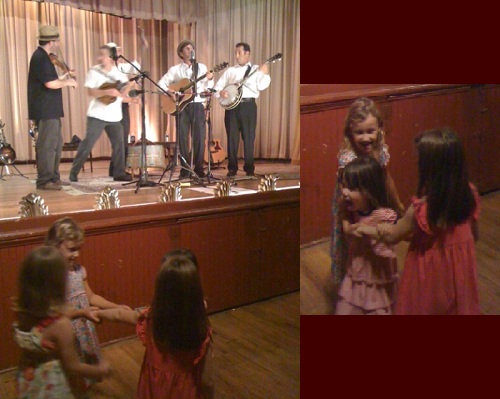
Children dancing at the "Delta Mountain Boys" concert at the Southern Cultural Heritage Center.

I recently attended a bluegrass concert where the music was as lively and dance-inducing as it ever gets.  And, as I looked around the room, I noticed that every single adult, without fail, sat straight and calm in their seat while their feet bounced in rhythm under their tables.   Try as they might (in order to maintain “dignity” and “self-respect”), they could not keep the dance inside.  Not completely.  It was wiggling out their toes, trying to escape.  But the children . . . they didn’t even try to keep it in.  They danced wildly around the floor as though no one was watching.  Or perhaps as though everyone was watching but they loved it.  When do we lose this sence of freedom?  What are we so afraid of?  Is it because we are so quick to judge others, that we assume everyone else is judging us?  Well, as my sister’s teacher told her in high school, “You’ll become much less concerned with what other people think of you when you realize how seldom they do.”   Children believe themselves to be the center of their own little world.  And with that understanding, they make the rules.  It doesn’t matter what other people think because it’s their world, after all.  As adults, we come to understand, rather brutally sometimes, that the world does not, in fact, revolve around us.  But some residual part of that belief holds on and we still believe that people are analyzing every little thing we do, because, I mean, why wouldn’t they?  But despite our immense worry, people are far less preoccupied with the things we do than we give them credit for.  And most people are much less judgemental than we often assume.  When you see someone dancing spiritedly at a concert, unconcerned about how professional they look or whether or not they’re messing up their hair . . . just dancing, do you think, “Look at that stupid person!  Why don’t they just sit down?”  Or do you smile and wish you had the nerve to live in the moment as they did?  If your answer is the former, than you deserve to be self conscious and fearful, because you will probably receive the same judgement you give out.  But if it is the latter, know that MANY people have that same thought.  And most likely they admire you for taking chances and living outside of a box.  Perhaps if we all lost a bit of our inhibitions, and let our kids teach us as much as we teach them, we might inspire one another to live a bit more vividly, with open eyes, open arms, open hearts, and more than just our toes dancing!

Unlikely Friends

I am a people person. Far more than most. Although, I think getting older has made me a bit more cynical or selective about who I chose to befriend. But I recently found myself wondering if that is a good thing. Shouldn’t age and wisdom teach us tolerance and open-mindedness rather than keep us bound to the immaturity of judgementalism? All people, from all ages, walks of life, classes, and cultures have something to offer. We can all learn from each other if we are open enough to receive the lessons. Even from people we deem to be beneath us. Perhaps especially from them. I have learned more from my son in the two years he has been on this planet than I have from many of the “intellectual” adults I have encountered. I have learned more from old people who many would call out-of-touch than I have from some of the hippest acquaintances I have made. Some people who I may have initially thought too immature to contribute much to a balanced friendship, end up being the light-hearted relief that I crave in the middle of an otherwise stressful time. Others, for whom everything seems to come easy, who have never had to fight for their supper and electricity, may once have spawned jealousy in me, but lately inspire gratitude for the richness that the struggle has brought to my life.

Unlikely friends

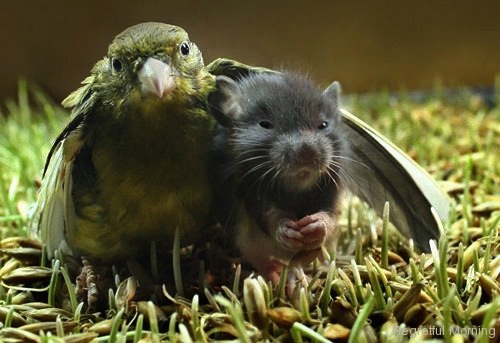
This awareness of the unseen value in friendships that we might not have initially given much of a chance, came yesterday as my husband was making plans with a relatively new friend. Without being asked, I volunteered that I was not very fond of this friend. My husband was quick to point out that I used to say the same thing about another of his buddies who’s friendship I now consider myself lucky to claim. If he had not prodded me to overcome my initial judgements about that person, I would have missed out on a valuable, affirming, kind relationship simply because I was too closed minded to be accepting. Patience with people is an immeasurable virtue I am only beginning to comb the depths of. Acceptance of differences is what connects us with people unlike ourselves and these people then bring balance and change to our lives in ways our other similar, like-minded friends never could have. Friendships come in all kinds of packages and sometimes it’s the oddest looking ones that have the most valuable contents.

Nostalgia Covers a Multitude of Sins

There are moments we know, without a doubt, that we will remember fondly. But it doesn’t mean that those moments were completely idyllic or picturesque. Often times, as we dive back into our memories, they are blanketed with a think layer of nostalgia that covers a multitude of sins. Family gatherings, for instance, are often fraught with familial tensions. Unspoken but implied criticisms. Hurt feelings or frustrations. But these are not the things we remember. We remember with rose-colored glasses the good times. The unguarded enthusiasm of children experiencing things for the first time. The brash and also unguarded comments of the aged who no longer feel the need to bother with social niceties. Fingers in mixing bowls getting smacked by mammas. Christmas presents opened just a smidge at the corner when no one was looking. Or endless games of monopoly in which we seek to dominate our beloved.

But it struck me this weekend as I experienced just such a moment of pure nostalgia in the making, that it is often incredibly hard to get past the difficulties that exist in those moments so that we can see, all around us, the things we are sure to remember fondly. Why is it that we so often only appreciate things that have already passed? It is because we’re too busy dealing with the stresses of the present to notice. But shouldn’t our memories, time and time again, be a lesson to us to let go of the things that don’t matter in the present? If we can just find it in us to brush off a harsh word, let go of unwarranted criticism, or never return the slight of someone else in kind, we can remember, in the present, the love that holds us together and the joys that are the building blocks of our memories.

This weekend found me and my family in a very small town in northern Mississippi where my husband was participating in a reunion concert for a local band who’s first gig occurred 40 years previous. It was astonishingly beautiful. Already, I remember it warmly. But I do regret allowing myself to be taken up with some of the stresses that surrounded the weekend. Some of them were silly stresses. Some of them serious. But none of them will factor into the beauty of the memory. What did it matter, in the long run, if the hotel room was old and small? Or if my sick son was a bit whinny and slept in my arms for most of the concert? That, in and of itself, will bring a smile with its memory. Was it really justified of me to feel somewhat jealous of the time I didn’t get to spend with an old friend when he was surrounded by family, friends, and a girlfriend he doesn’t get to see often enough? Should I have allowed myself to embody the stresses of those around me who were prepping for the concert or dealing with their own family tensions? Or should I have been an oasis for those same people – a stress free zone to refresh their mind and spirit? Of course, none of these difficulties compared with the wonderful beauties that the weekend afforded. Such as the constant bombardment of strangers telling me how wonderful my husband was both as a person and as a musician and how much they appreciated his help over the last several months. Or seeing the pure excitement on my son’s face, despite being sick, as he watched his daddy play in a concert. Or witnessing old men relive the passions of their youth with unrivaled enthusiasm and the support of their home town for their endeavor. And seeing a mother dance with her grown son, my friend, as though no one was watching and imagining myself and my son, who was sleeping in my lap, dancing in their shoes in the not so distant future. This is the stuff of life. All the rest is not worth remembering, and so, it is not worth dwelling on.