Helping Hands

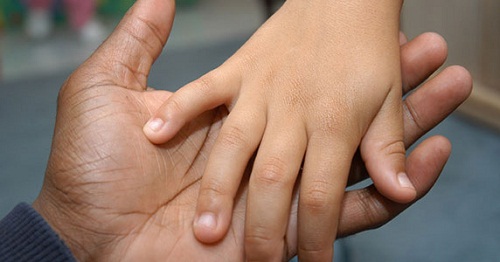
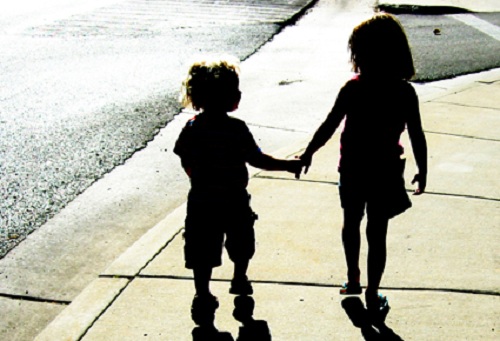
Have you ever noticed that children are extremely apt and ready to help one another when they are in need? They have not yet learned to be cynical and wary of others. They see a need that they can meet and they jump to fulfill it. For instance, if Aiden is at the park and unable, due to size or age, to overcome an obstacle, another child will, perhaps shyly, reach out his hand and offer assistance. I have seen this simple and beautiful gesture time and time again. And when it happens, Aiden will excitedly exclaim, “Mommy, he helped me!” On the other hand, if an older child, who has begun to learn that sense of self-righteousness that we all seem to attain as adults to varying degrees, refuses to help or turns his back, Aiden will look at me confused and almost hurt, not understanding that what is natural to him does not come naturally to everyone.
And it is not just other children that these little ones are prone to help. Their desire does not discriminate by age. Whenever there is something that needs doing, like the dishes or sweeping the floor, cooking supper or carrying groceries, I hear the constant refrain, “Mommy, I wanna help!” I must admit, I sometimes see this eager offer as an annoyance, knowing that his “help” will actually be more of a hinderance. It is sadly ironic that now, while he is extremely willing to help, he is not very capable and when he becomes capable, he might not be so willing. But I know that if I let my annoyance show, I will only aid in the development of his cynicism. So help me he does with undeterred enthusiasm.
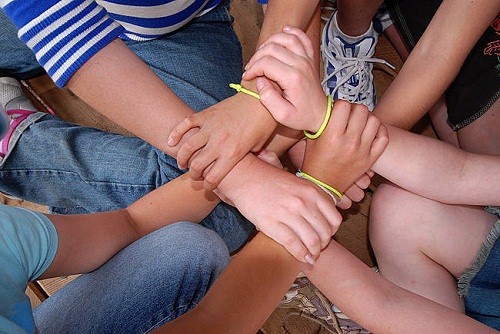
As I have said many times before, children sometime make the best teachers. I count myself blessed to learn such wonderful lessons from my son on a regular basis. I am humbled by his simple, unassuming, and poignant nature that seeks out the positive and finds wonder in the smallest of things. And what a lesson this is! If we, as adults, had a fraction of the helpful attitude of children, how much happier would our lives become! Because rather than seeking to serve ourselves most of the time, we would be actively serving others and, in turn, countless people would be serving us, doing far more than we could ever do for ourselves. That is what communities are all about.
Overcoming Fear

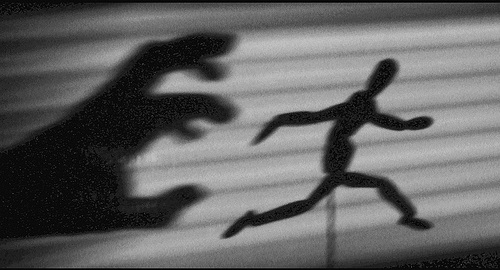
Lately I have been contemplating fear. Not as an entity in and of itself, but rather as an opportunity to overcome. There is no bravery without first encountering fear. If there is nothing to overcome, than we have not conquered, we have merely attained. And the level of satisfaction gained from conquering an obstacle against all odds and overcoming our fear of failure is far greater than living with a”better safe than sorry” mentality that lets our fear get the better of us and, in the face of failure or foe, backs down and waits for something more easily attainable to present itself. This choice is ever-present in our daily lives, from the smallest difficulties to the biggest decisions.

My son faces this decision to conquer or retreat multiple times a day as he attempts to overcome his fear of the dark. Sometimes fear gets the better of him . . . sometimes he of it. And his reaction, in the end, is remarkably more exuberant when he succeeds. If he discovers there is something he really wants in his room, but he has to go down the dark hallway to get it, he can either overcome his fear and at least make it to the light switch or he can beg me to come with him all the way down the hall. If he manages to do it himself, get the prize he was after, and make it back to me in one piece, he will inevitably squeal, “Mommy, I did it all myself!” and the object he went to get will hold his attention far longer than if I had gone with him to get it. It’s value was increased by the method in which it was attained. What a simple little picture of the decisions we as adults face on a regular basis.

In discussing with my husband whether or not we should try to have another child, we found many reasons to be afraid. What if we can’t afford it? What if something goes wrong and the baby is not healthy? We have been so lucky with Aiden and our experiences with him have been a remarkable journey of parenting. What if the next one is not the same? What if we can’t love him/her as much? What if our life is too unsettled? We are, after all, trying to sell the house and the car, and are constantly considering career paths . . . and so on. But no time is ever perfect. Life is never settled or ideal. And the benefits can be so wonderful. For Aiden, for us as a family and as parents. Do we let fear make that decision for us or do we overcome our fear of the unknown for the growth and betterment of our family? We chose to overcome, come what may.

We were also faced with a choice this week of whether or not to make an offer on a new house, contingent on the sale of ours. The whole scenario will only work well if we dramatically reduce the price of our house to one that is more comparable with those of our neighborhood so that we can sell it quickly before the house we want sells out from under us. However, if we reduce the price of ours, we can’t reasonable raise it again. So we will be stuck in that price range, and only able to afford houses that are somewhat less than our ideal should this offer fall through. It is a gamble. But do we fold before the flop, and pass on this house that is a great opportunity at a great price because we are afraid we might lose it? Or do we try our best and let the chips fall where they may? We stayed in the game.

If we can approach life mindful of our fears, but not ruled by them, constantly seeking ways to overcome and grow stronger, then we will live a life with few regrets, knowing we tried and that is the best we can do.

Just Singin’ and Dancin’ in the Rain!

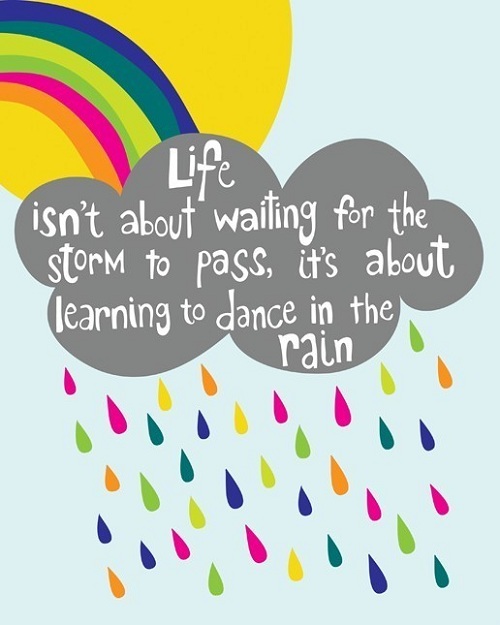
I came across this quote recently that resonated with me in a big way:

In trying to find who the quote was attributed to, I quickly discovered that it is a rather clichéd saying that can be found on such kitschy items as pillows and coffee mugs, calendars and cookie jars. But as I have said before, often times things are clichéd for a reason. Because they express or embody something that rings true for so many of us. This is certainly the case here. Life is full of storms. We cannot avoid them. They come and go and hopefully they make us stronger. And, to quote another cliché, often when it rains it pours. In those times, when we feel completely flooded by the storms life brings, it is all too easy to wallow in a nearby puddle. To spend more time whining to our spouse or coworkers or friends then we spend trying to find a solution. I am as guilty of this as anyone. But this simple little quote is a reminder to stop sitting on the sidelines, safe and dry, waiting for things to get better and start making them better. Get out in the thick of it and turn an affliction to joy. Don’t drag your feet through the water and wish things were different, dance in it. Jump and shout and scream if you have to, but dance!

Are Your Crutches Disposable?

What is a crutch? It is something that holds us up when we cannot stand on our own. Physically, emotionally, mentally. We all have them. But a crutch can be a good thing or a bad thing. Where the line is drawn is often vague. A simple question to ask ourselves is, do our crutches help us get somewhere we could not otherwise get on our own? If we are able, but unwilling to move forward without them, then they are enabling our weakness. We would be stronger if we could let them go and walk on our own.

My son, at two and a quarter, decided, by himself, to give up his paci because pacis are for babies. This was something that he had leaned on for comfort and calm his entire life. He had never spent a night without one. But, realizing that he was big and strong and didn’t need it for the same reasons any longer, he let it go. Not entirely without struggle, but most things worth attaining do not come without struggle. Similarly, I, after ten years of relying on nicotine for stress relief and relaxation, have learned that I am capable of handling stress in different ways. Better ways that do not harm me physically. And I have let it go. Not perfectly, and again, not without struggle, but I now no longer lean on that crutch for stability.

There are so many things in our daily lives that serve as crutches to help us avoid the pain and struggle of learning to walk alone. Television, alcohol, video games, social networks, you name it. As infants, none of us can walk without a crutch or a prop of some kind until we learn to stand stably on our own two feet. This is true of emotional stability as well, but unfortunately we have many emotional infancies. Moments of rebirth or redefinition that require us to prop ourselves up till we regain our footing. And those props often become so familiar and comfotable that we have a difficult time letting them go and learning to be stable again. And then, sometimes, certain things happen that leave us crippled in such a way that we cannot stand on our own without the aid of something or someone else. And that is okay. Recognizing weakness that cannot be worked through alone is a brave and noble thing. One that we should never be ashamed of. On a recent trip to the zoo, my son saw a crippled man walking with braces because his legs were bent. And, in typical toddler fashion, he loudly exclaimed, “Mommy, what’s that?” Rather than shush him as many parents are apt to do, I told him openly and within earshot of the man that those were crutches that helped the man walk because his legs were hurt and he couldn’t walk on his own. Amazingly, the man smiled and the look in the his eyes could only be described as relief that someone had actually acknowledged him. And I found myself wondering how it must feel to walk through life with no one meeting your eye because they are ashamed to acknowledge your handicap. How often are we ashamed to acknowledge each others weaknesses. To look one another in the eye and affirm, non-verbally, that we have nothing to be ashamed of.

So which are you, the man walking with a cane not because he needs it but because he finds it debonaire while everyone else finds it ridiculous? Or the man who has a handicap he cannot overcome without the help of a crutch, but with which he can accomplish so much?

Compliments or Criticisms?

There is extraordinary power in the words we speak to one another. Be they negative or affirming, they are capable of completely making or breaking a moment, a day, a relationship. This, of course, is more true of some of us than others. I am a word person. I have never taken any of the “love languages” tests, but if I did, I feel fairly confident that ‘words of affirmation’ would be the primary vocabulary in which I speak. (‘Receiving gifts’ would be second, but that’s an entirely different blog post!) My husband, on the other hand, is an ‘acts of service’ kind of guy. He will do whatever needs doing without blinking an eye. He thrives on taking care of me and our son. Need groceries? He will go, after a long day at work, to get them in order to spare me the hassle of going with a toddler. Is there a huge mess after the elaborate supper I just created? He’ll clean it all up while Aiden and I play so that I don’t have to cook and clean. Getting behind on the laundry? He can do it while listening to a podcast (one of his favorite pastimes), so no biggie! I know that I am extremely lucky. Many women would kill for what I have. I recognize these things are a demonstration of love that I would never trade. Unfortunately, they just don’t speak to me as a gesture of affection. Whereas a note left by my coffee in the morning will make my entire day. Or an offhanded remark about my outfit will make me feel sexy for a week. Why is it that such seemingly frivolous things seem to speak so much more loudly to me than practical things that really matter? I think the answer lies in the availability, or lack thereof, of such affirming words. Not just between husbands and wives but in all types of relationships. We as a society are, unfortunatly, not in the practice of lifting one another up – being generally encouraging or even interested in others. And this lact of verbalizing about things we admire, makes the rare compliment seem so unusual and valuable. I want to change this aspect of society. Every time I think something nice about someone else, I want to have the nerve to speak it, knowing it will probably make their day.

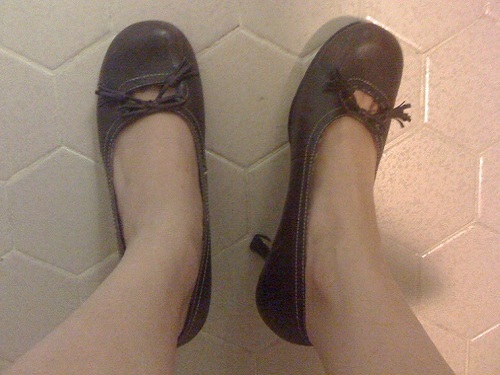
We tend to be so much better about doing this naturally with children. “Good job, sweetheart! What a beautiful picture you drew!” And yet, for some reason, we assume that, as adults, we just don’t need encouragement. We’ve all got this thing called life down pat by now, we shouldn’t need someone telling us what a good job we’re doing at it. But even if we don’t need the encouragement to succeed, it sure makes the path so much more rewarding! My husband recently went on a short business trip and when he returned, he seemed to be buzzing for days. When I asked him where all his positive energy was coming from, he said that he had met someone on his trip who was exceptionally good at being interested in and encouraging everyone that he met. And it was sincere and uplifting and inspiring. Why are people like this so rare? Why do we find it so hard to say nice things about and to one another? Shouldn’t this be the norm rather than the exception? I have a friend who taught me to fly a remote control helicopter. I was a natural, if I do say so myself, but I didn’t have to say so myself because he said it to me. As I was leaving, he kissed me on the head and said I did such a good job and that it was rare for someone so new to flying to do so well. Such a small and insignificant thing, but it made me feel good for days. I hope and pray we are training our son well in this aspect of life and relationships. And lately, he’s been complimenting me at such a rate, that I think we are succeeding. The other day as he was bent over for me to wipe his booty, he said, “Oooh, mama, I yuv your bootiful shoes!” I smiled all day. Later that week as I was trying on some clothes at a thrift store, he repeatedly told me, “I yike dat one! Dat one’s nice mama!” And these are not just the cute nothings of a two year old. They mean something! Perhaps we should all take note and learn to praise with the unreserved honesty of a child. If we complimented half as much as we criticized, we’d probably all feel a lot better about ourselves . . . or at least our footwear.